Most deals don't die from a "no". They die in silence.
Why follow-ups are the most neglected part of small-business sales — and how to make them happen without thinking about them
Think about the last ten sales emails you sent to people who did not answer. How many of them did you follow up on?
If you are like most small-business owners, the honest answer is "a few, when I remembered". Not because you did not care — because following up is the kind of task that is always important and never urgent. There is always something more pressing than "write to that person again, politely, in case they missed it".
And yet the people who did not answer were rarely saying no. They were busy. They opened it on their phone, meant to reply later, and later never came. A second, short message in the same thread is often all it takes.
"I meant to follow up" might be the most expensive sentence in small-business sales.
Why follow-ups don't happen
- You have to remember who did not reply — across every campaign.
- You have to remember when you wrote to them.
- You have to make sure you do not write again to someone who already answered, unsubscribed or became a customer. That fear alone stops many people from following up at all.
That is a lot of bookkeeping for one short email. So it does not get done.
Follow-ups that send themselves
In Cold Leads (Team and Business plans) you can add up to three follow-ups to any campaign. For each one you choose a template and how many days to wait after the previous email — 1, 2, 3, 5, 7, 10 or 14 days.
Then it runs on its own:
- the follow-up goes out as a reply in the same email thread, so the conversation stays together in the recipient's inbox ("Re: …");
- it respects the same daily sending limits as the campaign;
- it is sent from the same mailbox as the first email.
And, just as important, it stops by itself. A contact's follow-ups stop when they:
- reply — any reply at all after the first email;
- unsubscribe or bounce;
- are on your do-not-contact list;
- become a customer.
So the fear of "what if I nag someone who already answered" goes away. If they answered, the sequence is already over.
What you see
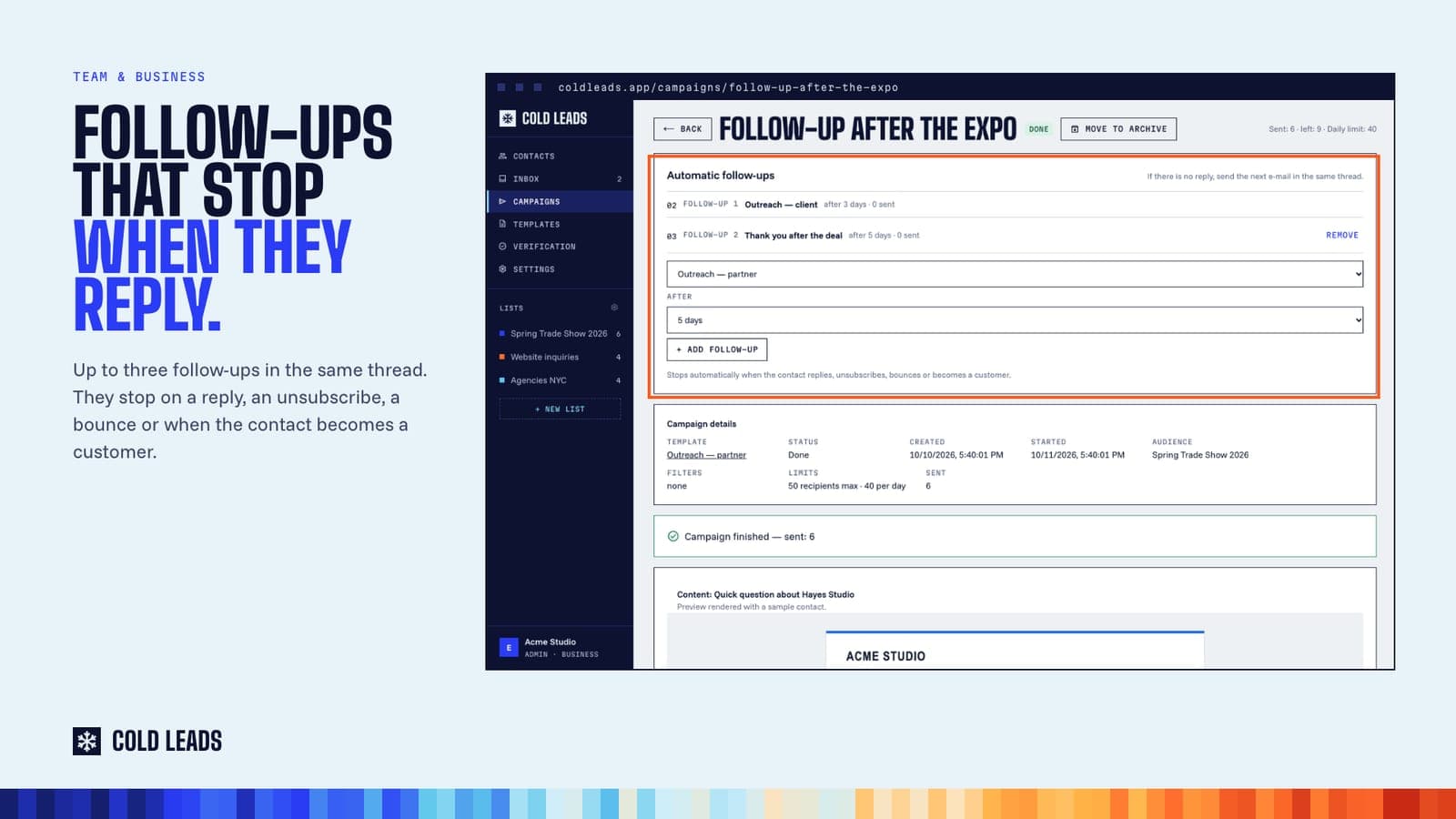
On the campaign page, a follow-ups card lists every step: which template, after how many days, and how many have been sent so far. You can add a step or remove the last one at any time.
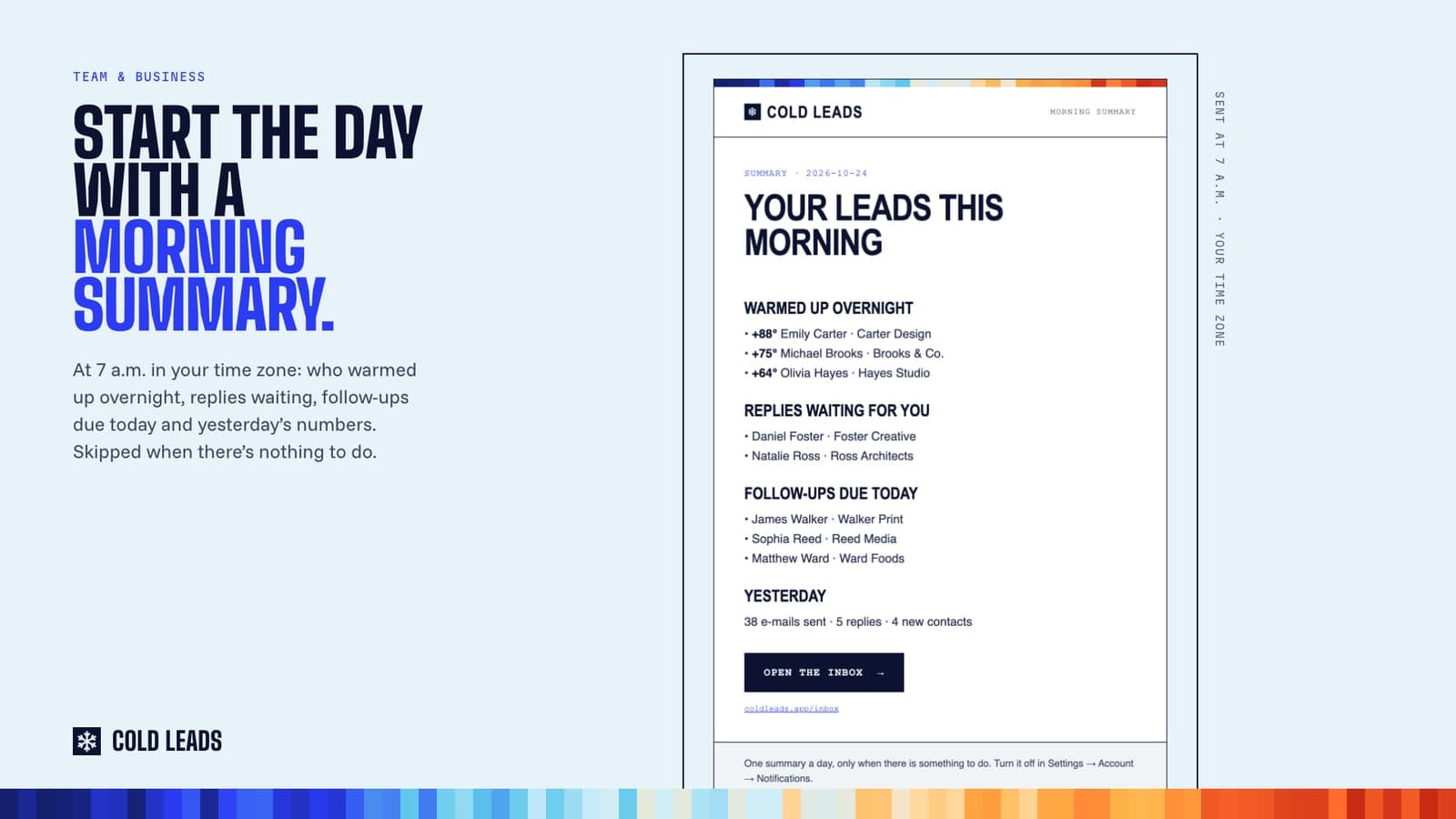
In your morning summary (also Team and Business), follow-ups due today show up next to the replies waiting for you — so the day starts with a clear list rather than a guess.
Keep them short
A note from experience rather than from the software: the best follow-ups are short. One or two sentences, in the same tone as the first email. "Just checking this didn't get lost — would a short call next week make sense?" You are not re-pitching; you are making it easy to answer.
The point
Following up is not pushy. It is what busy people need from you. The only reason most of us do not do it is that it depends on remembering — and remembering is exactly the kind of work software should do for you.
Read more: coldleads.app/solutions/automatic-follow-ups
Cold Leads Team plan: $49 a month, up to 4 team members. New accounts can try it free for 5 days (card required).
Try Cold Leads on your own leads
Capture inquiries, verify addresses, draft with AI and send from your own mailbox. Plans from $19 a month; new accounts get 5 days free (card required).